Skip to content

Environmental Impact

Amfori BEPI (Business Environmental Performance Initiative) helps us improve environmental performance across our supply chain. It provides tools to assess environmental risks in factories, reduce impact on the planet, and promote sustainability throughout our operations.

At the moment we are collecting data from our suppliers, including risk assessments on topics such as biodiversity, waste management, and chemicals.
Packaging

To protect our clothing as best as possible during delivery to our customers, items are packaged in a recycled polybag (plasticbag) inside an FSC Recycled cardboard box.

Shipping box
Grass-based cardboard

Our mailing-boxes are made from grass cardboard. Compared to conventional cardboard, which is typically made with only wood pulp and recycled paper, grass cardboard replaces up to 50% of the wood pulp with dried grass fibers.

Grass is a rapidly renewable resource, making the production process more environmentally friendly. The production of grass cardboard results in 50% less CO₂ emissions compared to traditional cardboard. It also uses up to 90% less water, 65% fewer chemicals, and up to 30% less energy.

Eco
Shipping bags and boxes

Our shipping bags and large boxes are made from fibers sourced from sustainably managed, certified forests (FSC forestry). FSC Recycled means that 100% of the fibers come from recycled wood.

FSC Recycled wood is divided into two types: pre-consumer and post-consumer wood. Pre-consumer refers to waste from wood or paper during the production process. Post-consumer refers to used paper or previously used wood.

Bag
Polybags

All our polybags are made from recycled plastic. Recently, we’ve reduced the size of our polybags to decrease plastic use.

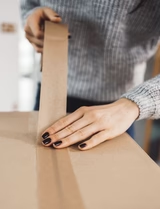
We also instruct our suppliers to limit the use of plastic and (tissue) paper as much as possible. Every season, we check our warehouse for compliance. Additionally, we use paper tape instead of plastic tape when packing boxes.

World
Transport

When it comes to transporting our goods, we striveto make choices that are least harmful to the environment. We have a
no-airfreight policy, meaning that in 99% of cases, our clothing is transported by boat, train, or truck.

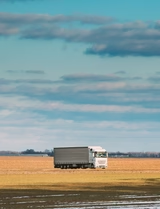
Delivery truck
From producer to King Louie

The route our goods take varies by production location. Items made in Turkey are shipped via sea along an international route to the port of Trieste, Slovenia. From there, they travel by train to northern Germany, and then by truck to Enschede (NL), where our fulfillment partner's warehouse is located.

 Goods from China arrive by ship at the port of Rotterdam. In Rotterdam, the goods are distributed via inland shipping (the most sustainable option) or by truck to our warehouse.

Room for improvement

Due to delays in China caused by energy shortages, COVID-19, and rapidly growing consumer demand, we've recently had limited opportunity to use inland shipping, as it is the most time-consuming option.

To minimize delays, goods from China are currently transported by truck from Rotterdam to our warehouse. We hope to return to the more sustainable inland shipping route soon.

In the future, we aim to ship goods from China more frequently by train (instead of by boat) to further reduce environmental impact. However, due to the war between Russia and Ukraine, this project is currently on hold.

What can you do yourself?

Try to make informed decisions while ordering new clothes, so that you won’t have to return any items. Pay close attention to the size and product specifications and contact us if you have any questions.

Do you need to return an item after all?

Please note that you can return multiple items in the same box.

Would you like to make use of the most sustainable delivery option?


Choose a pickup point near you.

×